





If you’ve ever felt your heart race at the sound of a dental drill, you aren’t alone. For decades, the high-pitched whine and vibration of traditional tools have been the primary sources of dental anxiety. However, a quiet revolution is happening in modern clinics. Laser dentistry is transforming the patient experience, offering a way to treat everything from cavities to gum disease with remarkable precision and—most importantly—minimal discomfort.
In this guide, we’ll explain how dental lasers work, why they are often considered pain-free, and how they are setting a new standard for oral healthcare in 2026.
What is Laser Dentistry?
At its simplest, laser dentistry uses highly focused beams of light energy to perform various dental procedures. These lasers act as an incredibly precise cutting or vaporizing instrument. Unlike a traditional drill, which relies on friction and pressure to remove tissue, a laser interacts with the water and minerals in your teeth and gums to achieve the same result without the physical trauma.
Dentists generally use two types of lasers:
- Hard Tissue Lasers: Specifically designed to cut through tooth structure. They are used to prep teeth for fillings, remove old composite resin, and even detect early-stage cavities that might not show up on a standard X-ray.
- Soft Tissue Lasers: These are optimized for the gums. They are perfect for treating periodontal disease, reshaping “gummy” smiles, or performing biopsies with almost no bleeding.
Why Is It Called “Pain-Free”?
The term “pain-free” isn’t just a marketing buzzword; it’s rooted in the physics of how light energy interacts with the human body. Here is why patients are trading the drill for the laser:
No Friction or Vibration
The “pain” of a traditional drill often comes from the heat generated by friction and the intense vibrations felt through the jawbone. Lasers do not touch the tooth. Since there is no physical contact, there is no vibration, which significantly reduces the “jolt” many patients fear.
Natural Numbing Effect
In many cases, the specific wavelength of the laser has a mild numbing effect on the tissue it touches. For shallow or medium-sized cavities, many patients find they don’t even need a local anesthetic injection. This means no needles and no “fat lip” sensation for hours after your appointment.
Instant Cauterization
When a laser is used on soft tissue, it seals blood vessels and nerve endings instantly. This results in significantly less bleeding during the procedure and almost zero swelling afterward.
Common Procedures Made Easier with Lasers
Laser technology is versatile, making it a go-to for both restorative and cosmetic treatments:
- Cavity Preparation: Lasers can remove decay and “etch” the enamel to provide a better bonding surface for your filling, often faster than a drill.
- Gum Disease Treatment: For patients with gingivitis or periodontitis, lasers can kill bacteria deep in the gum pockets and remove infected tissue without the need for scalpels or stitches.
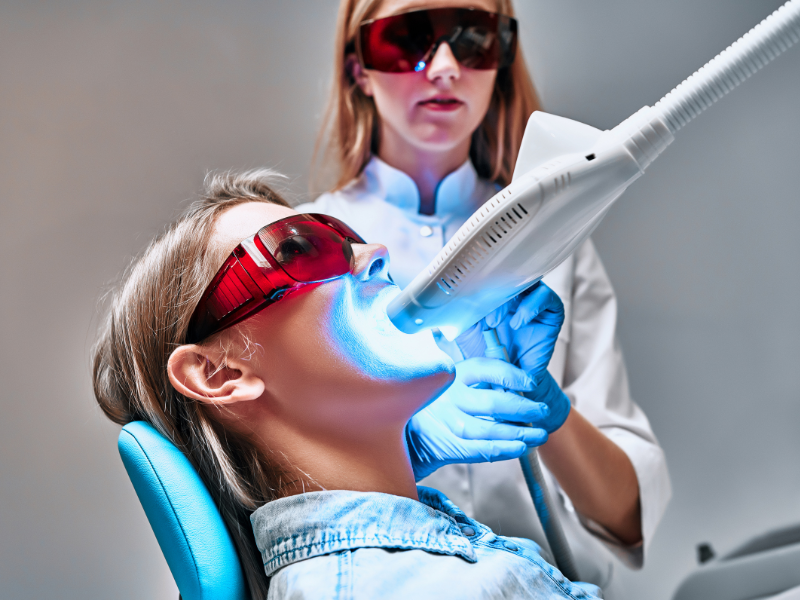
- Teeth Whitening: “Power bleaching” uses lasers to speed up the chemical reaction of whitening gels, giving you a brighter smile in a fraction of the time.
- Treating Sensitivity: If you have hot or cold sensitivity, lasers can be used to seal the tubules on the tooth’s root, providing long-lasting relief.
What to Expect During Your Visit
If you choose a laser treatment, the experience will feel quite different from a traditional check-up. Instead of the loud buzzing of a drill, you’ll hear a gentle “tapping” sound. You will be required to wear special protective glasses to shield your eyes from the light, but the rest of the procedure is usually faster and much more relaxed.
Because there is less trauma to the mouth, the recovery time is nearly non-existent. Most patients can go straight back to work or eat a meal immediately after, especially if no anesthesia was required.
Is Laser Dentistry Right for You?
While lasers are incredible tools, they aren’t a 100% replacement for every dental tool. For example, they can’t be used to remove old silver (amalgam) fillings or to shape a tooth for a crown in certain situations. However, for the majority of routine dental work, they offer a safer, faster, and much more comfortable alternative.
If you have dental phobia or simply want a more modern approach to your oral health, it’s worth asking your provider if they offer laser-assisted treatments.